

Do HVAC UV Lamps Really Kill Mold? What Works
Quick Summary
HVAC UV lamps can destroy some mold on wet coils and drain pans where the light reaches, but they are not a complete fix. They do not clear dead growth or stop regrowth, so removal and moisture control are still needed.
- A lamp that only passes by mold will not reliably kill it.
- Exposure time and direct line of sight decide whether the dose is effective.
- UV-C inactivates spores but leaves dead mold and debris on the surface.
- Mold needs damp surfaces, so fixing condensation and drain problems stops regrowth.
- Turn the unit off before servicing and never look directly at an operating bulb.
Table of Contents
- Do HVAC UV Lamps Kill Mold on Coils and in Ductwork?
- How UV-C Light Affects Mold Spores and Growth
- What Kills Mold Spores Best: UV-C, Moisture Control, or Removal
- How to Plan HVAC UV Light Installation and Placement
- Using UV-C Light for Mold Prevention on Coils and Drain Pans
- HVAC UV Light Ozone Risk and Material Compatibility
- Booking Your Next Step: Choosing and Maintaining an HVAC UV Lamp
- Frequently Asked Questions
Do HVAC UV Lamps Kill Mold on Coils and in Ductwork?
Last Updated: October 28, 2026
HVAC UV lamps can destroy some mold on coils and drain pans, but they are not a complete fix for a mold problem. Think of them as one tool that works only where the light actually reaches. Most people who buy a UV lamp expect it to clean their whole system, and that expectation is where things go wrong.
At HQ Telecom, we sell 14-watt UV-C lamps for HVAC systems. The short answer is yes, under the right conditions. The longer answer depends on where the mold is, how long the light hits it, and whether moisture is still feeding it.
The U.S. Environmental Protection Agency states that UV lamps may destroy some molds growing on moist HVAC interiors. That wording matters. It describes a narrow effect, not a general cure. U.S. EPA guidance on whether UV lamps kill mold
Watch out: A lamp that only passes by mold will not reliably kill it. Exposure time and direct line of sight decide the result.
How UV-C Light Affects Mold Spores and Growth
UV-C light damages the DNA and RNA of microorganisms, which prevents them from reproducing. That is the core mechanism, and it is why UV-C is called germicidal. But the effect is not automatic: it depends on the dose delivered to the mold spore or growing surface. Dose is a product of intensity and exposure time, and intensity falls off sharply with distance and is blocked by any shadow or opaque material.
Mold spores are more resistant than many bacteria, so the dose needed to inactivate them is higher. A lamp that only passes air by in a fraction of a second delivers far less than one that continuously bathes a wet coil. This is why coil-mounted lamps, which sit close to the target surface and run continuously, are the most common effective application. Duct-mounted lamps treat moving air and surfaces in the air path, but their dose is lower and less predictable.
There is an important distinction between killing mold and removing it. UV-C can inactivate spores and stop them from reproducing, but the dead spores, hyphae, and debris remain on the surface. Inactivated mold can still be allergenic and can still be visible. UV lamps do not clean, scrub, or flush contamination. If you need the mold gone, physical cleaning or component replacement is required, and UV-C is a preventive layer on top of that. Because UV-C leaves dead spores and debris behind, lasting indoor air quality depends on pairing it with physical cleanup and ongoing attention to moisture and ventilation, a balance AllerGsolutions connects to the broader work of maintaining a healthy home.
Lennox notes that HVAC UV-C can help on wet coil surfaces, where it can slow biofilm and odor buildup. That is a surface benefit, not proof of full removal. Lennox explainer on UV light and mold
UV-C Versus Other Ultraviolet Wavelengths
UV-C is the wavelength band used for germicidal work. Other ultraviolet bands, such as UV-A, are used for different purposes and are not the same tool. When you shop, check that the product lists UV-C and a germicidal wavelength, not a generic "UV" label. Wavelength matters because the absorption peak for nucleic acids is in the UV-C range; a lamp outside that range may produce light but not the same microbial effect.
What Kills Mold Spores Best: UV-C, Moisture Control, or Removal
Three approaches work together, and none replaces the others.
- Removal: Visible mold on coils, pans, or ducts must be cleaned or replaced. UV does not clear dead growth.
- Moisture control: Mold needs damp surfaces (the WHO). Fixing condensation, drain problems, and humidity stops regrowth at the source.
- UV-C: Helps inactivate spores on surfaces the light reaches, which slows recolonization.
If you only add a lamp and leave the moisture problem alone, the mold tends to come back.
The article compares three approaches to mold, and each one plays a different role.
| Approach | Role | Limit |
|---|---|---|
| Removal | Clean or replace visible mold | UV does not clear dead growth |
| Moisture control | Stop condensation and drain problems | Mold needs damp surfaces to regrow |
| UV-C | Inactivates spores on surfaces the light reaches | Only where light actually reaches |
How to Plan HVAC UV Light Installation and Placement
Placement decides whether the lamp does anything useful. Common locations include the evaporator coil area and the air handler or return duct. The goal is direct, unobstructed line of sight to the coil face, drain pan, or duct surface you want to treat, with the lamp close enough to deliver meaningful intensity.
120V UV Lamp for A/C Air Handlers & Coil Systems →
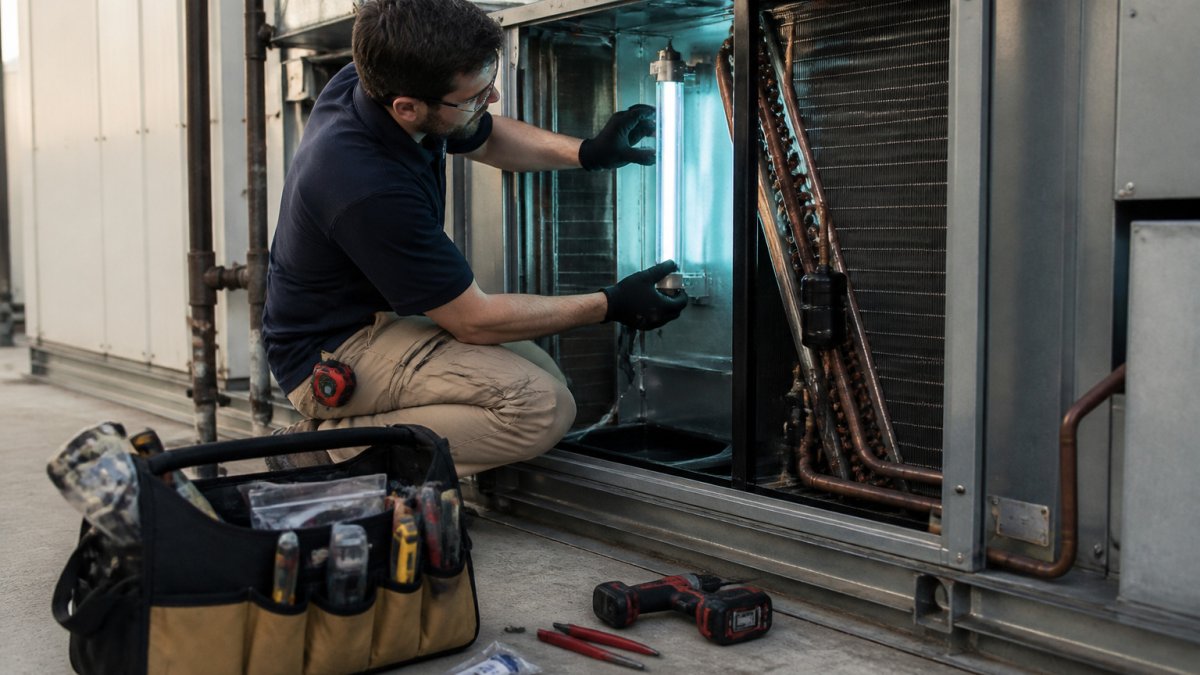
Before installing, check that the system is sized correctly. Our 120V coil lamp is rated for air handlers up to 5 tons. Product: 120V UV Lamp for A/C Air Handlers & Coil Systems

- Shut off power at the disconnect or breaker and confirm the unit is de-energized before opening any panel.
- Choose the mounting location so the lamp has a clear view of the coil or drain pan and is not blocked by wiring, refrigerant lines, or insulation.
- Check voltage and ballast compatibility, match the lamp to the system's 120V or 24VAC supply and confirm the ballast is rated for the lamp.
- Mount the base and route wiring away from sharp edges and heat sources, following the manufacturer's instructions.
- Seal penetrations so air and moisture do not bypass the cabinet.
- Restore power and verify operation using the lamp indicator or a brief, shielded visual check, never look directly at the bulb.
Distance, Line of Sight, and Exposure Time
Light intensity drops quickly with distance, and shadows block it completely. Aim the lamp so the target surface has a clear, direct view. Exposure time is the other half: the longer the spores sit under the light, the greater the dose. A lamp that cycles air past it in a fraction of a second delivers far less than one that bathes a coil continuously.
Safety, Maintenance, and Replacement Intervals
UV-C is harmful to eyes and skin. Never look at an operating bulb, and turn the unit off before servicing. Keep the lamp away from people during maintenance, and follow the installation instructions for shielding and cabinet interlocks.
Ozone is a separate concern. UV-C lamps that produce ozone can irritate the lungs, so ozone-free operation matters. Our 14-watt bulbs are rated ozone-free, which is a useful point to confirm on any product you consider.
Using UV-C Light for Mold Prevention on Coils and Drain Pans
Prevention works best when the lamp runs continuously on a wet coil.
Coil-side protection is the most common use. For a 24-volt system, our 24VAC coil lamp matches that voltage. Product: 24VAC UV Lamp for A/C Air Handlers & Coil Systems

Keep a few habits in place:
- Clean the drain pan on schedule.
- Fix leaks and standing water quickly.
- Check that the lamp indicator light is on.
- Replace the bulb when the lifespan ends.
HVAC UV Light Ozone Risk and Material Compatibility
UV-C lamps that produce ozone can irritate the lungs, so ozone-free operation matters. Our 14-watt bulbs are rated ozone-free, which is a useful point to confirm on any product you consider.
Material compatibility also matters. Check that the mounting bracket and surfaces around the lamp handle the heat and light over time. Keep UV lamps away from people during service, since direct exposure to the eyes and skin is harmful. Follow the installation instructions and turn the unit off before opening the cabinet.
Booking Your Next Step: Choosing and Maintaining an HVAC UV Lamp
Start by deciding whether your problem is surface growth, air quality, or both. Then match the lamp to your system's voltage and size. Our replacement bulb fits the 120V and 24V lamp models.
Our UV-14 replacement bulb is compatible with the 120V and 24V lamp models. Product: UV Light Replacement 14" Bulb for 24V or 120V Lamps Track the bulb's age and replace it at the end of its rated life, because a weak bulb delivers too little dose to matter.

If mold is already visible, clean or replace the affected parts first, and fix the moisture source before relying on any lamp.
Frequently Asked Questions
Can UV light kill mold?
UV-C light can inactivate some mold spores and growth on surfaces it directly reaches, but it does not remove existing mold, dead spores, or staining. The U.S. EPA states that UV lamps may destroy some molds growing on moist HVAC interiors, which means the light is a control measure rather than a cleanup method. Exposure must be direct and sustained, so a lamp that only sees air passing by will not treat growth reliably. Existing contamination still needs cleaning, and the moisture source must be fixed to stop regrowth.
Do HVAC UV lamps create ozone?
The listed HQ Telecom coil-system UV lamps and replacement bulb are described as ozone-free. Ozone can irritate airways, so check the specification sheet before you commit to a lamp for an occupied space.
Are HVAC UV lamps safe to use around people and pets?
The bulb should never be viewed directly while energized. Eye and skin exposure to UV-C is the main hazard.
What kills mold spores best?
Mold spores are best controlled by a combination of moisture control, physical cleaning, and UV-C where the lamp can reach the growth. Reducing humidity and condensation removes the conditions mold needs, while cleaning removes the existing colony. UV-C does not replace either step.
