

How to Reduce Mold in HVAC: 7-Step Cleaning Guide
Table of Contents
- How to Reduce Mold in HVAC: Step-by-Step
- Confirm the Growth Is Actually Mold
- Find the Moisture Source First
- How to Clean Mold from Air Vents and Ductwork
- How to Prevent Mold in HVAC Ducts
- HVAC Humidity Control That Actually Works
- Does an HVAC UV Light for Mold Help?
- When to Call a Professional
- Frequently Asked Questions
Last Updated: October 21, 2026
How to Reduce Mold in HVAC: Step-by-Step
Mold in an HVAC system is a moisture problem before it is a cleaning problem. This HQ Telecom guide walks through a seven-step process for any small office or home: confirm the growth, find the water source, clean the right parts, then prevent regrowth.

Most guides jump straight to bleach. That is the mistake. Mold spores are everywhere in outdoor air, so killing a patch on a coil does nothing if the drain pan still holds water. The steps below fix the cause first.
Here is what we cover, in order:
- Confirming the growth is actually mold
- Measuring moisture before you clean
- Cleaning vents, ductwork, coils, and drain pans safely
What You'll Need Before You Start
Total time: 2 to 4 hours for a single air handler and its vents. Difficulty: Moderate. You will be opening panels and reaching into ductwork.
Gather these before you start:
- N95 respirator and nitrile gloves
- Safety glasses
- A spray bottle with a diluted household bleach solution prepared to label directions or hydrogen peroxide
Confirm the Growth Is Actually Mold
Mold is a fungus that grows on wet surfaces and releases spores into the air. Before you spend a weekend cleaning, confirm you are looking at fungal growth and not dust, rust, or lint.
Check three things:
- Smell. A musty, earthy odor near a vent usually points to mold or mildew.
- Appearance. Mold shows up as fuzzy patches, black speckling, or greenish film on the coil, pan, or duct lining.
- Wetness. Touch the spot. If it is damp, you have a moisture problem regardless of what is growing.
Dust wipes away clean. Mold smears and leaves a stain. Rust is orange-brown and crusty. If the growth sits on fiberglass duct liner, treat it as mold until proven otherwise, because porous liners trap spores.
Find the Moisture Source First
Water is the real problem. Mold cannot grow on a dry surface, so chasing the growth without fixing the water guarantees it comes back.
Work through the usual suspects in this order:
- Clogged condensate line. Algae and sludge block the drain, water backs up into the pan, and the pan overflows.
- Standing water in the drain pan. A pan that does not slope properly holds water permanently.
- Frozen or dirty evaporator coil. Ice melts, drips, and keeps the surrounding metal wet.
Measure before you fix. A moisture meter on ductboard or drywall should read in the normal range for the material, and a room hygrometer should show relative humidity under 60%. If you cannot get below that, the moisture source is bigger than a cleaning job.
How to Clean Mold from Air Vents and Ductwork
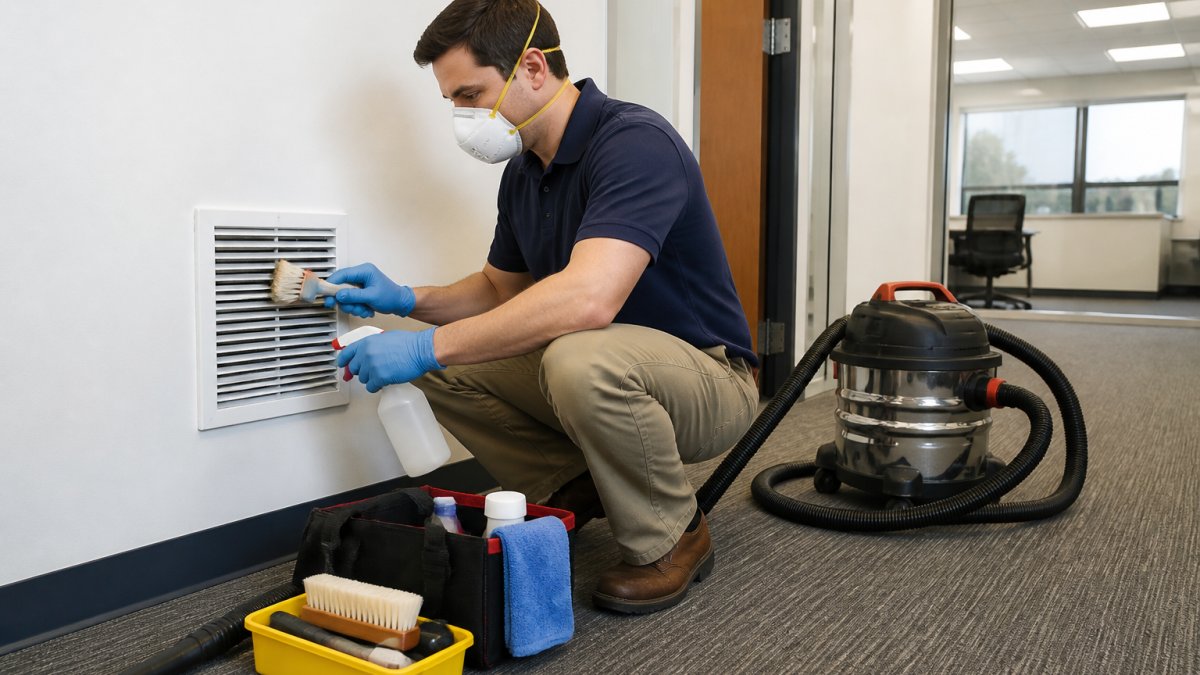
Cleaning mold from air vents and ductwork means removing the growth physically, disinfecting the surface, and drying it completely. Vacuuming alone spreads spores, so always wet the surface first.
Safety and cleaner selection first
Before you touch any surface, choose a cleaner that matches the material and contamination level. No single product is right for every part of an HVAC system.
- Diluted household bleach (prepared to label directions) works on non-porous surfaces like metal pans and coil fins, but it is corrosive to some metals and can damage rubber gaskets. Never mix it with vinegar or ammonia-based cleaners; the combination releases chlorine gas.
- Hydrogen peroxide (3% household strength) is a gentler option for coils and pans, but it can bleach fabrics and should not be used on aluminum without testing first.
- EPA-registered HVAC coil cleaners are formulated for specific coil materials and are the safest choice when the label matches your equipment.
Always wear an N95 respirator, nitrile gloves, and safety glasses. Ventilate the space and keep the HVAC system off at the thermostat and breaker while you work.
Central air systems (ducted)
For a standard central air system with accessible ductwork:
- Turn off the system at the thermostat and the breaker.
- Remove vent covers and wash them in a utility sink with soapy water.
- Mist visible growth with your chosen cleaner so spores stay put.
- Scrub the surface with a nylon brush, then wipe with a damp cloth.
- Vacuum the surrounding area with a HEPA vacuum.
- Dry the cover and the opening fully before reinstalling.
For accessible ductwork, wipe down only the first few feet you can reach. Do not spray liquid into duct runs; standing moisture inside a duct is worse than the mold you started with. If fiberglass duct liner shows growth, replace it rather than cleaning.
Window units and portable ACs
Window and portable units have smaller, more accessible components but tighter clearances. Unplug the unit, remove the front grille and filter, then clean the evaporator coil and drain pan with a coil cleaner or diluted hydrogen peroxide, using a soft brush to avoid bending fins. Window units often have a small drain hole or sling that clogs easily; flush it with water and confirm it drains freely.
Mini-split systems
Mini-splits have a wall-mounted indoor head with a blower wheel and coil prone to mold. Turn off power at the breaker, open the front panel, remove the filters, and clean the coil with a no-rinse coil cleaner or diluted hydrogen peroxide. Reach the blower wheel with a soft brush or mini-split coil brush, and never spray liquid into the electrical compartment.
UV-C Lamp for Mini Split A/C Air Handlers & Coil Systems →
Apartment and multi-unit systems
In apartments, the HVAC system may be shared or have limited access. If you rent, check your lease before opening any panels; some systems require landlord or building maintenance to do the work. Vertical fan coils and PTAC units clean like window units, but the drain pan may be harder to reach. If you cannot reach the coil or pan safely, or the system serves multiple units, call building maintenance rather than attempt a partial cleaning that could spread spores.
After cleaning
Reassemble, restore power, and run the system. Watch the drain pan for a full cycle to confirm the drain is clear, and photograph the cleaned area so you can compare if growth returns. Follow the cleaner label for any required rinse or dwell time before restoring airflow.
How to Prevent Mold in HVAC Ducts
To prevent mold in HVAC ducts, keep the duct interior dry and stop moisture from entering the airstream. Prevention is mostly maintenance discipline.
- Replace the air filter on schedule. A clogged filter restricts airflow, which lets the coil freeze and drip.
- Seal duct joints with foil tape or mastic so humid attic air cannot leak in.
- Insulate cold duct runs in unconditioned spaces to stop condensation.
HVAC Humidity Control That Actually Works
HVAC humidity control means keeping indoor relative humidity low enough that condensation does not form on cold surfaces. Aim for 30% to 50% indoors; above 60%, mold and mildew thrive.
Practical ways to get there:
- Fix the sizing. An oversized system cools fast and dehumidifies poorly. Longer run times remove more moisture.
- Lower the fan speed. Slower airflow across the coil pulls more water out of the air.
- Use a dehumidifier in damp basements or crawlspaces that feed the return air.
A cheap hygrometer in each zone tells you whether your changes are working. Check it weekly during humid months.
Does an HVAC UV Light for Mold Help?
An HVAC UV light for mold helps as a supplement, not a substitute for drying and cleaning. Germicidal UVC lamps emit light at 253.7 nanometers, a wavelength that damages the DNA of mold, bacteria, and viruses passing under it.
What a UV lamp does well:
- Keeps the coil surface cleaner between professional cleanings
- Reduces microbial growth on the wet coil and drain pan area
- Helps with musty odors coming from the air handler
What it does not do:
- It will not clean a duct run that is already contaminated
- It will not fix a leaking pan or a clogged drain
- It only treats air and surfaces that pass close to the bulb
For offices and homes that want continuous treatment at the coil, HQ Telecom stocks UV lamps sized for residential and light commercial systems.

When to Call a Professional
Most HVAC mold problems caught early and confined to accessible surfaces can be handled with the cleaning steps above. But some situations require professional containment, removal, or assessment, and a DIY fix can spread contamination or damage equipment. Use the criteria below to decide.
Clear signs you need a professional
Call a professional if any of these apply:
- The mold covers more than about one square meter of duct surface or coil area. Large areas need containment and proper removal to avoid spreading spores through the building.
- Growth is inside fiberglass duct liner or insulation. These porous materials cannot be cleaned well enough to trust; they must be removed and replaced.
- You cannot find the moisture source after working through the diagnostic steps. A technician can measure static pressure, check refrigerant charge, and confirm whether the system is oversized, root causes a cleaning cannot fix.
The limits of visual inspection and testing
Not every stain or musty smell is confirmed mold. Visual inspection only tells you growth is present, not the species or whether it is active. A hardware-store test kit confirms presence but not species or source; for a definitive answer, especially with health concerns or a real estate transaction, a professional can take a tape lift or air sample. Testing is often unnecessary for a straightforward cleaning job; visible growth plus a moisture source is enough to act.
DIY vs. professional: a quick decision guide
- DIY is reasonable if: the growth is on accessible metal or plastic surfaces, covers less than one square meter, you have found and fixed the moisture source, and no one in the space has respiratory sensitivities.
- Call a professional if: the growth is in porous materials, covers a large area, you cannot find the moisture source, the system is shared or in a multi-unit building, or the growth keeps returning.
A professional can also advise on whether your system is oversized, whether duct sealing or insulation is needed, and whether a UV lamp or other supplemental treatment suits your setup.
Frequently Asked Questions
Can mold in AC ducts make you sick?
Airborne mold spores blown through vents can trigger allergy symptoms such as sneezing, coughing, itchy eyes and congestion, and people with asthma or existing respiratory sensitivities often react more strongly. The CDC notes that mold exposure does not affect everyone the same way. If occupants report symptoms that ease when they leave the building, treat it as a signal to inspect the air handler, coils and ductwork. Cleaning the system and fixing the moisture source matters more than air fresheners or masking odors.
Can a UV lamp in an HVAC system help reduce mold?
A germicidal UVC lamp mounted at the coil or in the ductwork shines light on surfaces where mold and bacteria collect, and it can help keep the coil and drain pan cleaner between service visits. It works best as part of a routine that also fixes moisture problems. HQ Telecom's 120V and 24VAC 14-watt lamps are designed for air handlers up to 5 tons and run continuously, with an LED indicator that shows when the bulb needs replacing after its roughly 9,000-hour lifespan.
When should HVAC mold be handled by a professional?
Call a licensed HVAC contractor or remediation specialist when growth covers more than about one square metre of duct lining, when porous insulation or fibreglass board is affected, or when the system has been wet for days after a leak or flood. The same applies if you cannot find the moisture source, if occupants have ongoing symptoms, or if you smell a strong musty odor after cleaning. Professionals can measure humidity, inspect concealed ductwork and replace contaminated components safely.
How often should HVAC filters be changed to help prevent mold?
Check filters every 30 to 60 days and replace them when they look grey or clogged, or at least every three months in a typical office. A loaded filter restricts airflow, which lets the evaporator coil run colder and stay wet longer, and that standing moisture is exactly what mold needs. Use a filter rated MERV 8 to MERV 13 for most offices, make sure it fits snugly with no gaps, and write the change date on the frame so nobody has to guess.
Mold keeps coming back when the moisture never gets fixed. That is the whole game. If your building needs a practical, low-maintenance way to keep the coil and drain pan cleaner between service visits, HQ Telecom can help. Our UV lamps for HVAC systems run 24/7 on a 14-watt bulb, install with a magnetic bracket or a taped duct base, and come with a one-year warranty plus a 90-day bulb replacement. Get started with HQ Telecom and give your air handler a drier, cleaner operating environment.